

 Return to
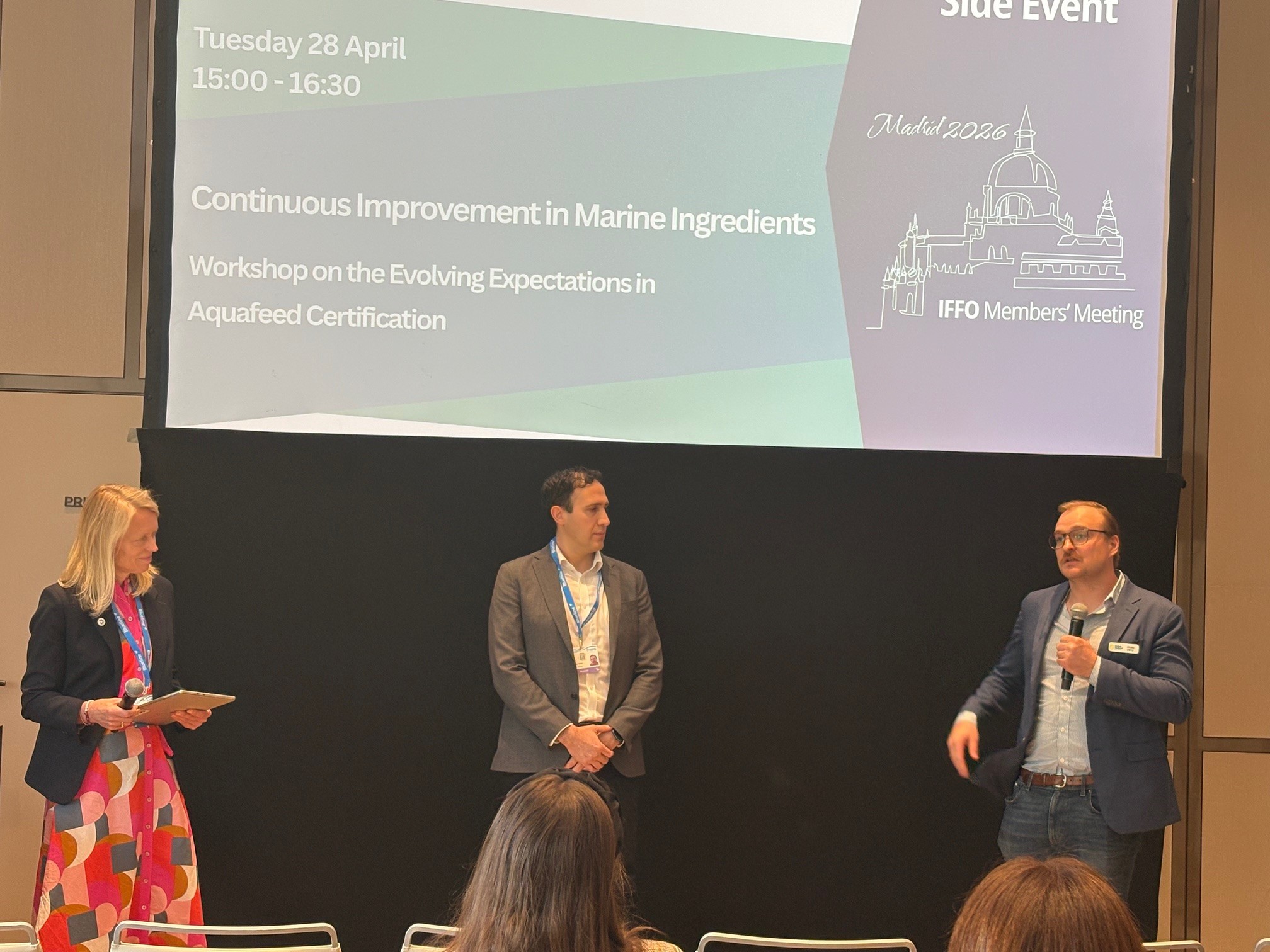
 A joint workshop led by MarinTrust and the Global Seafood Alliance (GSA) was held as a side event for delegates attending the IFFO Members Meeting. The session examined the evolving expectations placed on aquafeed certification, with a particular focus on marine ingredient assurance in an increasingly complex landscape of commitments, standards and market expectations.
The workshop was chaired by Libby Woodhatch, Executive Chair of MarinTrust, and featured contributions from David Dietz, Manager of Standards Oversight at the Global Seafood Alliance, and Jorge Díaz Salinas, Director of Sustainability and Communications at Skretting.
Retailer expectations and traceability
Speakers emphasised that expectations around marine ingredients originate at the retailer level and cascade throughout the value chain. Retailers are currently most focused on two areas: human rights and feeds. As a result, traceability has become a non‑negotiable requirement across all stages of production. However, participants acknowledged a significant gap between retailers’ expectations and the operational reality faced by feed producers and suppliers.
Global Seafood Alliance and BAP requirements
David Dietz outlined the scope and evolution of the Best Aquaculture Practices (BAP) programme, which has now been in operation for 25 years. GSA’s sustainability framework covers four core components (environmental responsibility, social accountability, food safety and animal welfare), and BAP currently certifies approximately 4,300 producers and 158 feed mills, representing 10.2 million metric tonnes of feed production worldwide. Tilapia and shrimp were identified as the leading contributing species, with Ecuador and Vietnam being the most represented producing countries in the standard.
Under current BAP requirements, at least 75% of crude fishmeal and fish oil (FMFO), calculated using a mass‑balance approach, must be sourced from fisheries certified under GSSI‑recognised standards or assessed through MarinTrust’s whole fish criteria. This threshold is scheduled to increase to 90% by the end of 2027.
BAP's requirements now extend to clear disclosure of fishmeal and fish oil inclusion rates for all aquafeeds. Feed mills are required to indicate the proportion of fisheries‑derived ingredients, reinforcing transparency and accountability throughout the chain.
Dietz also confirmed that a full revision of the BAP Feed Mill Standard will commence in 2026, signalling further evolution in response to market and stakeholder expectations.
MarinTrust assurance and alignment challenges
Libby Woodhatch explained that raw materials entering a fishmeal plant must be assessed either through a MarinTrust‑recognised fishery certification programme or via MarinTrust’s network of third‑party accredited auditors.
Feed producer's perspective from Skretting
From a feed manufacturer's perspective, Jorge Díaz Salinas highlighted that current traceability systems are insufficient to meet future expectations. Increased discipline is required, particularly with regard to blended oils, in order to safeguard the sector’s social licence to operate. Skretting operates within a highly complex supply chain and sees traceability as central to maintaining credibility and integrity.
By the end of 2025, 88% of Skretting’s marine ingredients were either certified or sourced from FIPs. Achieving 100% would have required an additional investment of approximately €20 million. Díaz Salinas stressed the need for a shared, value‑chain‑wide responsibility.
Certification was described as the most effective tool currently available, provided that standards remain realistic, clear and progressively stricter, while continuing to reflect market realities. Human rights considerations were identified as essential.
While certification remains the primary assurance mechanism, misalignment between different standards continues to present challenges. Notably, within the BAP framework, MSC and MarinTrust certifications are treated equivalently, whereas ASC operates a feed ladder approach in which these standards occupy different positions.
Conclusions
The workshop highlighted broad consensus on the importance of certification and traceability in aquafeed production, while also exposing ongoing challenges around cost, alignment between standards and uneven implementation across the value chain. Speakers agreed that the aquafeed sector is resilient, but that this resilience comes at a cost, requiring collaboration and a shared commitment to credible, practical certification pathways.